On Sunday, Greg took me around to some great London sights away from the main tourist drags. We started by walking through the Columbia Street Flower Market. It was Mother’s Day, so you can imagine. In the midst of the crush, I was grateful for my height. I explained to Greg that the only photos I posted on my Facebook page were of flowers in the garden, and I kept saying things like, ‘Are those belladonnas?’ but he seemed not to know. Perhaps I did have something up on him. Not that I’m competitive like that.
We saw someone who one lady said was a famous hairdresser. He had, of course, managed to get flowers without braving the stampede. I had no idea who he was. But he had terrible hair like Daryl Braithwaite in Sherbet.
We stopped at the Cat and Mutton for a Sunday roast. It was phenomenal – two huge chunks of pork belly with roast potatoes, peas, sweet parsnip, cauliflower with white sauce, and Yorkshire pudding. The feeling of home was palpable. And I loved the big photo on the wall of a cat staring at a leg of mutton. I asked Greg if he knew of any logic behind all the pub names in London. He said they were mostly fairly esoteric, I suppose to keep tourists wondering.
We spent the afternoon walking around East London, mainly Bethnal Green, Shoreditch and Dalston. The New River Walk in Islington, which the sign explains is neither new nor a river (actually an old aqueduct), was incredibly tranquil and we sat a while to take in the scene. [Despite all the walking I’ve done on this trip, I’ve tried to make an effort to stop every now and then and just take things in. I remember doing the same in Taroko Gorge and being met with Winston’s confusion.]
We passed by a canal populated by long thin covered boats. I asked Greg what they were and he said, ‘People live in them.’ I felt stupid for not figuring this out for myself, but had just never seen anything like it. One or two looked actually inhabitable but most seemed tiny and run-down. Until I have at least a houseboat to my name, though, I will refrain from passing judgement.
For dinner, Greg had booked a table at St John Bread and Wine. A London fixture, St John was one of the few things I read about before coming overseas, and I had always liked the sound of it. Their Bread and Wine outlet (where we were) is less formal and expensive than its counterpart Restaurant and Bar in St John Street, but still excellent. Greg explained to me that many of the top chefs will visit St John when in London just to get away from overly fussy restaurant food and into something simple but perfectly done.
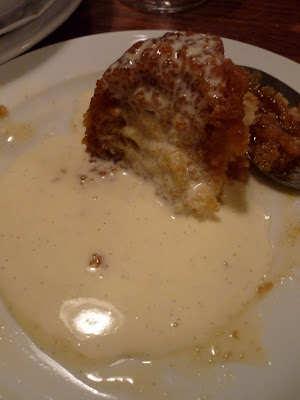
We ordered a bunch of small dishes to share, including sprats with horseradish, kohlrabi with watercress, ox heart with kale, and a middle white faggot (a sort of fat pork sausage) with mashed parsnip. All were delicious. For dessert, we ordered a treacle pudding with vanilla custard, big enough to share. The pudding was sweet and sunny, with the custard mellowing out the flavour. It was so simple and familiar but must be one of the best desserts I’ve had in a restaurant. I waddled home satisfied.
Monday morning I spent writing up my blog, then went out in the afternoon to explore London town, passing through lovely Regent’s Park and scouting around the circuses (Oxford and Piccadilly) for soundtracks or interesting shops. I was to meet my old uni friend from Australia, Sarah, for dinner and a West End play, which was going to be excitement enough for one day. The ninety minutes before I was to meet Sarah I spent looking, unsuccessfully, for a public toilet. How is it that in the middle of one of the world’s most active tourist hotspots, in a built-up retail area, no one needs to go to the toilet? Or is that, as Sarah later suggested, a peculiarly English thing?
I met Sarah at her office, situated glamorously near Oxford Circus and we went to a Japanese sushi train. As with Michael, it was great to see a familiar face and we had a lovely catch-up over a quick but delicious dinner. The play we saw was ‘The Little Dog Laughed’ by Douglas Carter Beane at the Garrick Theatre, starring Tamsin Greig, Rupert Friend, Harry Lloyd and Bond girl (apparently) Gemma Arterton. It was entertaining but the director seemed to want everything turned up to eleven. Still, I had a lot of fun, and it was so great to see Sarah in her new environment.
MY FAMILY (ON THE OTHER SIDE OF THE WORLD)NB: Apologies for any factual errors in the following.
It was only a year or two ago that I started interviewing my Nan, Edna, in the hope of perhaps one day writing up some kind of biography. We had a couple of taped hour-long sessions where I grilled her about her experiences growing up, the challenges she faced during the war and her move to Australia with her young family in 1960. The sessions were very tiring for her and she was reluctant to carry out any more, but in those two short sessions I managed to get a glimpse into what her early life might have been like.
Some of her stories were frightening, while others were more whimsical. One of the more poignant things she told me was about playing down by the canal at the back of her house as a young girl. In the poor and industrial environment of 1930s Manchester, it seemed, the canal was a place of refuge and fun. She would delight in leaping from one side to the other, always tempting fate, threatening to fall in. And she told me about the front step of the corner shop on Astley Street where she and the neighborhood kids would gather for games and mucking around.
When the opportunity arose to visit my extended family in Manchester and perhaps see a few of the places where my Nan grew up, I grabbed it. I was fortunate to benefit from the continued contact between my family in Australia and that of my grandparents’ niece, Sheila, in Manchester. Sheila and her husband, Lloyd, and their grown-up children and children-in-law, have become somewhat accustomed to hosting us Aussies, and I’d been fortunate to meet Sheila and Lloyd and a few of their number in Australia previously. But nothing could prepare me for the warmth of the greeting that awaited me in Manchester.
Lloyd met me at Stockport station and took me on a scenic route to their house in a suburb called Romiley. Set amidst hills and dales, with Manchester city centre at a comfortable distance on the horizon, the whole place seemed idyllic, a film of green moss covering tree trunks and rock walls everywhere I looked. Everything was on a small scale: the roads all single-lane, the houses no higher than two storeys. The traffic jam we encountered cleared in no time.
We arrived at their home, Pleasant View (circa 1883), where I chatted with Sheila and Lloyd for a while about all sorts of things. Though I’d only met them a couple of times before, I felt an unmistakable ease and comfort talking with them, and often had the sensation of being in my Nan’s old place in Newport. I had been told that their place was considered something of a ‘drop-in centre’ where any family member may show up at any time. Between their eight children, most of whom live locally, and many grandchildren, that’s a lot of potential drop-ins.
While I was there, two of their grandchildren, Alice and William, dropped by. At 16 and 14 years old, respectively, they struck me as very mature and sociable, moreso than I remember myself ever being at that age. Alice told me about her attempts at studying acting, and William about his sporting prowess. When Alice mentioned that she also played flute and piano, William muttered something disparaging. Alice hit him playfully. Suddenly I really missed my sister, Jen, towards whom I may have once or twice been similarly antagonistic.
Their mother, Sharon, came and collected them and told me she was looking forward to dinner. A booking had been made at a nice local place called the Joshua Bradley. Before dinner, Sheila, Lloyd and I chatted some more and showed me some pictures of old Manchester in comparison with Manchester today, including the mine where my Pa and his brothers used to work. I also discovered that Jane, their eldest daughter, and Alan, her husband, had offered to take me around tomorrow to some of the sites of my Nan’s youth. This was tremendously exciting.
Lloyd dropped me around to the house of their youngest daughter, Katie, and her husband Dave, who was out for the night at an Editors concert (the only father-of-three I know who would do that – very hip) and I got to meet her lovely children Liam, Abigail and Thomas. Having just arrived home from parents’ night at school, Katie had lots of feedback for Thomas, who himself had just arrived home from a badminton lesson, and Liam had some excellent drawings to show me. (And I mean excellent. There was no way I could have drawn a tree that well at age seven.) Abigail was demonstrating her fine French skills and I had that strange feeling again of inferiority. My special skill at their age was squeezing my fat belly together and saying, ‘Look at the donut.’
Katie took me out to the Joshua Bradley, where we met with more family members: their sons Terry (husband to Sharon), John and Tony; daughters Jane (and husband Alan) and Sheila; and granddaughters Catherine and Danielle. Everyone made an effort to make me feel comfortable, for which I was very grateful, as I’m not the least awkward person I know, and the food was sensational. Curious to taste both gammon steak and black pudding, I ordered a mixed grill, which I can add to the Strasbourgian choucroute on the list of vegetarian nightmares. The plate offered tastes of gammon steak, black pudding (surprisingly herby and light) and regular steak, alongside a generous serving of chips and salad.
[Sidenote: Regular readers of this blog are probably wondering how my arteries have managed to survive this trip. Honestly, I don’t know. But I only recommend eating like this if you’re going to walk between ten and twenty kilometres a day.]
At the conclusion of the meal, I got a bit emotional and took a moment to thank everyone for taking the time out to see me. I said something along the lines of being amazed at how a group of relative strangers could come together to make someone from the other side of the world feel so welcome, and I meant it. I wished, under the circumstances, that I’d been able to pay for everyone but, under the circumstances, they all chipped in for me, which was actually unnecessary but which blew me away nonetheless.
Wednesday held the promise of my trip out with Jane and Alan, and Sheila plied me with a delicious bacon and egg breakfast to prepare me for the day. Alan picked me up and took me to his house in Marple where we would wait for Jane to return from her pilates class (again – very hip). This gave me time to take in the peaceful view from their backyard and admire the huge copper fireplace in the lounge room.

We drove out to Clayton and Openshaw, only about twenty-five minutes away, and looked first for Astley Street, where my Nan had grown up. Unfortunately, Astley Street was gone, built over by some sort of factory, and Jane and Alan explained how the whole area was being redeveloped. Much of the surrounding area consisted of vacant lots, but some rows of terrace houses in nearby streets were still standing. These, though, were from a generation after my Nan had lived there, so Astley Street was only a distant memory. I didn’t feel disappointed, though. The place lives on as long as it’s remembered.
We drove a block down to the Ashton Canal, which still flowed at the back of the neighborhood. Used for transport before the advent of the train, these canals dodge and weave through many English suburbs, offering a kind of tranquility in the midst of high development. I could certainly see how my Nan would have found solace there, as well as fun.

Next was the search for the church where my grandparents married, my mother was christened and my Nan’s parents were buried: St Cross Parish Church, Clayton. After some uncertain driving around, and some assistance from a pair of locals, we found it. Parking on Clayton Hall Road, we walked past Clayton Hall (which was surrounded by an empty moat of some sort) to the church and into the yard. Knowing only that the grave was at the far end away from the church, but seeing that the yard was basically circular, we had no option but to scour for the names of my forebears: Simeon Hibbert and Fanny Hibbert (nee Jubb). Though Jane and Alan seemed doubtful that we would find it, I was somehow certain that we would.

We started on the south side and worked our way around the front, but it wasn’t until I reached the north side that I gasped as, almost magnetically, I was pulled to it. It was at this moment that I realised that the tears people shed on those ‘genealogy for celebrities’ programs might actually be real. To be there, at the place that had been in many ways responsible for my presence on Earth, was overwhelming, the feeling impossible to replicate in print.
I froze a moment, figuring out how to tell Jane and Alan, who were still scouring around, that I had found it. Eventually, the words came to me: ‘I found it!’ They were suitably amazed, especially because there were recent flowers and a couple of Christmas wreaths laid at its base. Someone had been here quite recently. As far as I knew, though, I was the first to come from Australia to see it (which is not actually the case - at least my Uncle Chris has visited - but it's what I thought at the time).
From there we went to check out the Manchester City Stadium, which had been built for the 2002 Commonwealth Games, but I’m not allowed to say much more about that at risk of upsetting my sport-loving family back home. Let’s just say I diplomatically declined Alan’s suggestion of purchasing a Manchester City jersey.
Over a delicious lunch back at Sheila and Lloyd’s, Sheila told me about their plans to visit London in the coming days to see the Van Gogh exhibition at the Royal Academy and take in a West End show. I tried to explain to them my feeling that everyone there was so hip and I was pleased to see Sheila understood and even agreed.
After a very nice stroll around Romiley’s own canal with Lloyd, ever-thoughtful Sheila gave me a snack bag for the trip back to London and the three of us drove to Stockport station. Even though I had only been in Manchester one night, I felt such a connection with these two lovely people that leaving was truly saddening. I hope they can return to Melbourne someday and I can find a way to repay their kindness and generosity.
The rest of the day was spent traveling through the lovely English countryside, the not-so-lovely streets of Shepherd’s Bush and the land of nod. Tomorrow I would fly to Boston.